
Signature Work.
The most meaningful work of my career has centered on helping organizations and executive leaders design and strengthen systems, build public trust, develop communities and turn bold ideas into lasting impact.
Explore a collection of frameworks, strategies and initiatives that reflect how I approach leadership and organizational change.
"There is no power for change greater
than a community discovering
what it cares about."
-Margaret J. Wheatley

When I joined Portland Public Schools, the district was navigating one of the most complex periods in its history: significant budget reductions, major organizational change and ambitious commitments that required both strategic leadership and public trust.
As Special Advisor to the Superintendent, I partnered with executive leadership to transform priorities into action by designing the systems, partnerships and engagement strategies that moved complex initiatives from vision to implementation. My work spanned executive strategy, organizational design, community engagement and cross-sector collaboration, ensuring that decisions were not only operationally sound but also grounded in authentic relationships with the communities they served.
Among the most significant initiatives was advancing the Center for Black Student Excellence from a long-standing vision into an acquired site in the heart of Albina. I helped shape the strategic direction of the initiative and led the intentional name change to the Michael Chappie Grice and Dr. Harriet Adair Center for Educational Excellence; inspired by two local educational giants in the City of Portland. I contributed to the development of the Birth-to-Brilliance framework, a cradle-to-career ecosystem to operationalize programming along a developmental continuum; and now support the planning, design and construction of the Grice-Adair Center for Educational Excellence as it moves toward opening in 2029.
I also designed the districtwide engagement strategy for Rightsize. Right Supports. Right for Students., creating the framework that guides how Portland Public Schools engages students, families, staff and community members throughout one of the most significant school consolidation efforts in district history. Beyond individual initiatives, I established new structures for executive-community partnership, including advisory models, engagement systems and governance practices that continue to strengthen communication, transparency and trust across the district.
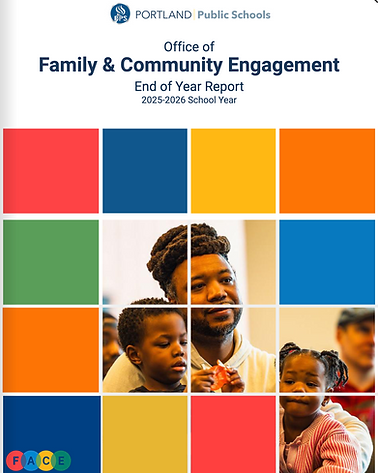
When I was appointed to lead Portland Public Schools' newly established Office of Family and Community Engagement (FACE), the opportunity was larger than launching a department; it was to redefine how a district of nearly 45,000 students partners with the communities it serves.
The 2025–26 End of Year Report captures the first year of building that vision into reality. More than a summary of activities, it documents the creation of the district's engagement infrastructure, including new governance models, student leadership councils, family advisory structures, principal engagement tools, executive reporting systems and districtwide frameworks that continue to shape how Portland Public Schools engages students, families and community partners.
The report reflects a year of designing systems that outlast individual initiatives. From establishing the Village Table as the district's first districtwide family advisory structure to launching the Student Voice Advisory Council, strengthening principal supports through the FACE Intranet and planning guide, and creating engagement strategies for district priorities such as Rightsizing and the Grice-Adair Center, the work focused on building sustainable structures that strengthen trust, increase participation and improve organizational alignment.
The End of Year Report serves as both a reflection of the office's inaugural year and a blueprint for the future of family and community engagement in Portland Public Schools.

As the sole staff member released to build out a teachers' union's first dedicated racial equity function, I translated a broad, largely undefined mandate:"Be revolutionary in our response to racism," into a structured year of work across five goal areas: community engagement, student voice, restorative justice, professional development, and internal advocacy.
That meant designing and facilitating community forums with Black and Latinx families, supporting schools through public incidents of racism in real time, and building trust with people who had every reason to be skeptical of the institution I represented.
I documented the year in a 200+ page report woven from firsthand essays by parents, educators, and union leaders; synthesizing difficult, often conflicting perspectives into a coherent account that could inform the union's future strategy. The work also required navigating significant organizational tension with care and discretion, as the report surfaced uncomfortable truths about the institution funding it.